
Disclaimer: I love fall, and not just for all the stuff below this paragraph. And I don’t mean “second summer” and all those warm October days we’ve gotten used to in the past few decades due to climate change. I mean FALL fall, like pumpkin spice everything, leaf colors and sounds, and clothes that just look better on me than shorts and a t-shirt. If you’re into sports, I mean, come on! MLB and WNBA playoffs, NASCAR’s Chase format is back, NFL and college football, and the NBA and NHL are starting up.
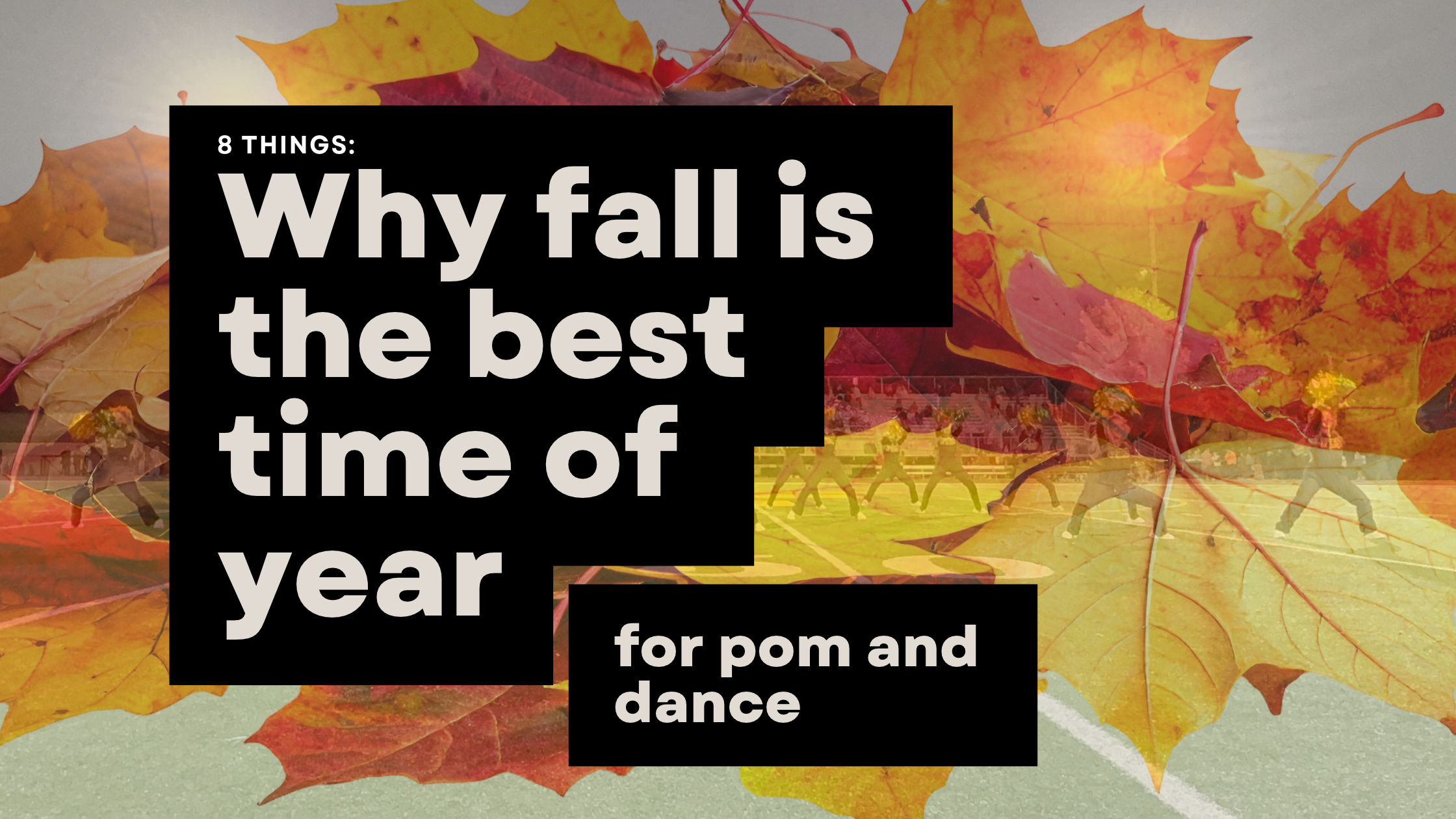
Here we go…8 reasons why fall is my favorite part of the pom and dance year:
1 – Fall halftime season is our sport’s purest form.
Unlike competition season, fall halftime routines are strictly about the performance and how that functions as part of the bigger Friday night picture. No rubrics, scores, or placements. No need for technical brilliance, highbrow artistry, or gritty athleticism. Design a routine that’s accessible to all of your dancers. Opt for choreo, concepts, and themes that make the dance accessible to all the fans. It’s about putting on a show and having fun doing it.
Every aspect of the routine is about the dance, and you don’t have to worry about hitting all the rubric columns, or what another team might bring. Precision and skills are great ways to spice up the dance, but the boldest flavors are showmanship and connecting with the audience. I’m not saying that what we see during winter isn’t pure. But those fall halftime routines? They get way closer to the foundational concept of a pom or dance team.
2 – It’s the gateway for new fans
Let’s say you’re a little kid who doesn’t take dance. What’s your first exposure to pom and dance? OK, it might be an older sibling or a really cool babysitter who dances. But in all probability, you first get to know what the sport is all about by watching the poms on the sidelines and at halftime.
And it’s not just kids. It’s your friends, classmates, teachers, admins — hell, the whole school community. If they even pay a modicum of attention at the game, they’ll figure out the difference between cheer and poms. These are your future dancers, parents of future of dancers, future fans in the winter bleachers, and other stakeholders (like maybe that one important person who has a big say in your program’s funding, stature, or even existence).
Ideally, the little kids will one day decide to wear a future version of your uniform…and maybe make room in their studio schedule for the school team. Ideally, a random student will get to know how awesome your performances are. But at the very least, it’s your Friday night halftime dance that educates a lot of people on what a pom and dance team even is.
3 – More athletes can participate
Comp season, on paper, is a competitive “cut” sport. In real life, it’s even more exclusive.
Fall halftime teams may or may not have “cut” tryouts. It’s more open to the idea of a kid who just likes to dance and wants to perform getting a spot on the team. Coaches are looking for heart, spirit, a bit of athletic ability, and some level of movement quality. All the other stuff — usually acquired by pricey, dedicated, decades-long training — is great but not essential during fall. In other words, it’s less exclusive.
And it’s more inclusive. Maybe that one kid does have a chance to make the winter team…but based on what she’s seen at competitions and on social media from other programs, it’s too intimidating to even try out. The fall halftime team is her realistic chance to wear the uniform, be part of the team, and have a share of the performance experience.
There has to be room for that kind of kid again. It used to be that way for the whole year (she’d just be an alternate or a back row dancer during the November-March competition season, but at least she’d be part of the year-round team). For now, that kind of dancer has a chance to shine on only four Friday nights a year. Not much, but we’ll take what we can get…and hence, another reason to love the fall version of our sport.
4 – We expect less and get more
I love me some precision…clean and maybe flashy skills…smart and deep concepts…the kind of on-floor artistry that makes me wish I wore a tie and blazer just to fit in with the occasion. On the other hand, in fall dances we’re not looking for the locked-in unity, or the crazy combos, or really anything worthy of display in the 8CA Hall Of Fame. Now don’t let that stop you from delivering on those things — they absolutely add to the pizzazz if you’ve got it. I’m just saying: we don’t need you to have those things in order to have a good time watching your performance.
And by needing less, we all get more. The audience enjoys a routine your team can totally pull off. Your team feels the good vibes of a good to great performance that the crowd clearly was into. Maybe one or two of your dancers even choreographed it.
5 – Dancers have more power this time of year
So many times I hear this from coaches: “During winter, I rule with an iron first, but during fall, I let the girls make more of the decisions.” That kind of ownership and buy-in (I like to call it a sense of agency) can be a powerful spark for an individual or an entire team. True, you can sometimes end up with so-so choreography or “meh” execution, but there’s a charming innocence when students pour their hearts into their creations and share it.
I’m probably being a little abstract, so I’ll try to contrast it with the worst form of the winter season cycle: receive the choreo, accept the costume and concept, recite it at competitions.
Power is a tricky thing. We have more than we think, and we have to learn to wield it responsibly. So here’s your chance. Is that turning jump a good call on your field in this weather? Costume choice X versus Y? Are the lyrics in that one line of the song ok for this crowd? Make your best decision, find out, and have fun learning.
6 – Flexible performance formats and styles
With JV? With cheer? With a neighboring dance team? How about mom, dad, and clunky football and soccer players? It’s all possible in a fall routine.
Or how about the fun pom routine that, for unfortunate reasons, you’re reluctant to bring to competition? Or maybe you’re a team of sassy jazzers who are just dying to throw down a hip hop crowd-pleaser. Here’s your shot at enjoying some flexibility in style.
Weather. Field conditions. The wandering refs and athletic staff. Band members setting up. Half your potential audience went to the bathroom or have lost the battle to ignore the grill smoke and bratwurst daydreams. Ok, not all those are good things, but they’re interesting and usually fun variables — or at least a refreshing contrast to the (necessary) sameness of the competition setting.
An adjacent point: sometimes I just wanna see an MJ pom mix. Sometimes the crowd just needs a kick line. Bonus points: those ultra-serious winter teams having some fall fun with a hip hop shuffle or making a pom picture.
7 – Dance and poms don’t feel as isolated as they do during comp season
Let’s face it. Dance teams live in a winter bubble. The stakes are higher, so you need to lock-in.
If it’s comp day, you might not be at that night’s basketball game. Or maybe you just run sidelines and not a routine — who’s got time to prep a halftime dance during practices? Or, if you do run a routine…well, I hope the wild hoops crowd enjoys a good ronds de jambe, because hey…it’s a gym, it’s a crowd, let’s run our sad lyrical routine for some real experience! And even if you’ve got a cute and sassy jazz ready for halftime, I bet you’re asking your coach if you can spend the 2nd quarter of the basketball game running through your comp routines in the dance room.
So even if you’re there and performing, there’s a serious disconnect between basketball games and dance teams, at least in this era of Illinois dance. Contrast that to fall: you’re an integral part of a long game night. The whole school has their collective eye on Friday night, all week (even if it’s an away game). And you’re part of the show (sidelining, performing, or even just attending that away game as a normal student). Your team isn’t the star of the show (except at halftime); instead, you’re part of something bigger.
Couple that aspect with the amazing charity events, extra performances, and parades during fall. This is the time of year when your dance team truly has a community role.
8 – The zest of Friday night
I ask this all the time when I interview teams: “What’s the best part about Friday night?” I usually get answers like, “The crowd — everyone’s here,” and getting to perform casual routines with friends. Other answers can get a little hazy, and maybe these are the best, because they struggle to articulate that abstract allure of a nighttime weekend football game.
I’m not sure I can describe it, either. Maybe you actually get a good football game, or maybe the scoreboard doesn’t matter too much. Who doesn’t like a big, cheering crowd? Being under the lights? Or the grill smoke wafting through the air… (2nd time mentioned in this article)? The pregame team meal. Going somewhere after the game. A mashup of all the characters in your life — teammates, friends, parents, annoying middle school siblings. All in one spot, for the game, for you, for the school community.
Comp day is exciting — but you’re probably pumped to go out there and put on your routine, maybe check out some of your fave teams, and have a little fun during the pre-awards dance party. That’s a lot different from the undeniable spark in the air during a Friday night game. And trust me, the sparks in life are special, even when they’re ordinary, and especially when they’re hard to describe.
I can’t promise there will always be exactly EIGHT “things” for these kinds of posts (get it?), but just like that aerial or quad of yours, I’m gonna aim for it anyway.